
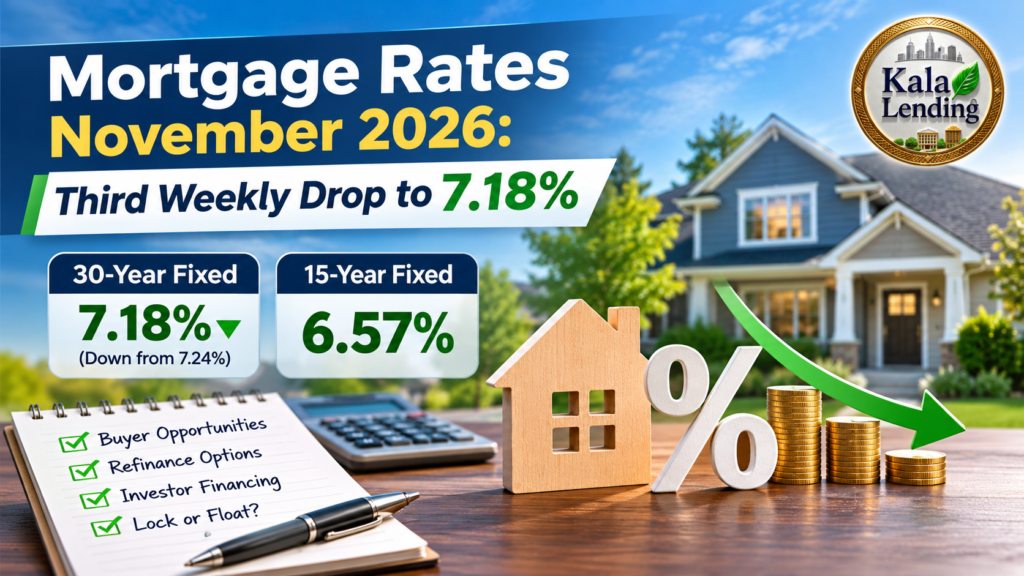
Mortgage Rates November 2026: Third Weekly Drop to 7.18%
Mortgage rates November 2026 are easing, but only slowly. Freddie Mac’s weekly survey, released November 5, shows the 30-year fixed-rate mortgage averaging 7.18%. That is down from 7.24% the week before and the third straight weekly decline, though still well above the 6.22% average a year ago. The 15-year fixed averaged 6.57%.
Mortgage rates have improved, but the relief is modest and the outlook is uncertain. Here is what happened this week and what it means for buyers, homeowners, and real estate investors.
Mortgage Rates November 2026: Where Rates Stand Today
Freddie Mac’s survey is the most widely cited national benchmark. It has now fallen from a mid-October high of 7.40%. On a $300,000 loan, the latest dip saves only about $12 a month versus last week.
Other trackers show different numbers on the same day. Zillow-based averages put the 30-year purchase rate near 6.86%, while Mortgage News Daily-style lender sheets sit closer to 7.17%. These gaps come from different borrower profiles, points, and methodology. Your actual quote depends on credit score, down payment, property type, and loan program.
A Strong Jobs Report Complicates the Rate Outlook
The October jobs report, released November 6, was stronger than expected. Employers added about 165,000 jobs, and unemployment slipped to 4.1%. Wages rose 3.1% year over year, and earlier months were revised up.
The Federal Reserve raised rates in September for the first time in about three years and held steady on October 28. After this report, the Mortgage Bankers Association and Oxford Economics both said a December rate hike now looks likely. MBA chief economist Mike Fratantoni said inflation remains too high and that mortgage rates are unlikely to fall quickly.
Oxford Economics noted one possible upside. Sustained declines in oil prices or tech stocks could remove the case for a further hike in early 2027.
Mortgage Applications and Housing Activity Remain Weak
High borrowing costs are still weighing on the market:
- MBA applications: Total mortgage applications fell 1.2% for the week ending October 30. Purchase activity is roughly 19% below a year ago, and ARM share rose to 11.4% as borrowers look for lower starting payments.
- Pending sales: Zillow reports newly pending listings fell 16.8% year over year in October, the steepest annual drop since August 2023.
- Monthly payment: The typical mortgage payment reached about $2,004, up 12.8% from a year ago.
- Prices and inventory: The typical home value is about $364,800, only 0.7% higher than a year ago. Active inventory is about 1.4 million homes, up 3.4%.
Zillow’s chief economist expects November to be weak but says the worst of the slowdown may come in the next month or so, with more upside if rates ease.
What This Means for Buyers, Homeowners, and Investors
Homebuyers: Rising inventory and slower price growth mean more room to negotiate, even though payments are high. Get pre-approved and compare loan structures before you shop. You can start with our apply now page.
Homeowners considering a refinance: At current levels, a rate and term refinance only makes sense if you are clearly lowering your rate or changing your term. If you need capital for a project or another purchase, a cash-out refinance can unlock equity, but model the new payment first.
Real estate investors: Investor financing is evaluated differently from owner-occupant loans. A DSCR loan qualifies you on a property’s rental income rather than your personal income. It can work well for a new purchase as rents keep rising. Zillow reports typical US rent up 2.9% year over year, the strongest gain in 19 months.
Flippers and builders: Short-term bridge loans, including fix and flip and new construction financing, can help you move on discounted properties while buyers hesitate.
Should You Lock or Float Right Now?
No one can reliably call the bottom. Strong jobs data and a possible December hike argue for caution. Falling oil prices or weaker data could push rates lower. If a payment works for your budget at today’s quote, locking removes the risk. If you are unsure, ask your loan officer about a float-down option or a program that fits your timeline.
Talk to Kala Lending
Kala Lending, LLC works with real estate investors, small businesses, and homeowners on a range of loan programs. Rates and terms vary by borrower and property, so the best next step is a conversation about your goals. Contact our team or start your application today. For more market updates, visit the Kala Lending blog.
Disclaimer: This article is for informational purposes only and is not financial advice or a rate quote. Mortgage rates change daily and depend on individual qualifications.